For the past few years, the mainstream narrative around generative artificial intelligence has been dominated by scale. By consuming vast swathes of internet text, large language models learned to predict the next token with astonishing fluency, writing code, summarizing documents, and passing professional board exams. Yet, beneath the surface of these probabilistic models, a quiet paradigm shift has been taking place. The frontier of AI research is no longer just about memorizing human output—it is about rigorous reasoning, formal verification, and navigating the exact sciences.
This shift is visible across multiple domains, from pure mathematics departments establishing dedicated research initiatives to hardware engineers using neural networks to reverse-engineer complex silicon layouts. As artificial intelligence evolves from a sophisticated autocomplete tool into an active partner in logical deduction, understanding this transformation is critical for technical professionals.
The Shift from Statistical Fluency to Formal Logic
Traditional language models are fundamentally probabilistic. When presented with a complex coding problem or a mathematical proof, they generate text based on patterns seen during training. While this often yields correct or plausible-looking results, it is notoriously susceptible to "hallucinations"—logical leaps that sound authoritative but collapse under scrutiny.
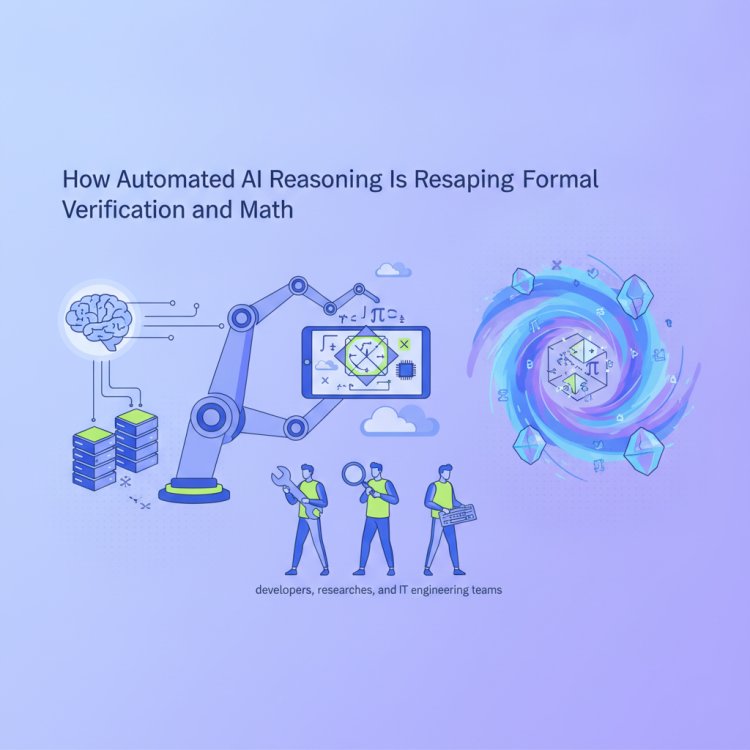
To overcome this limitation, researchers and developers are increasingly combining machine learning with formal theorem provers and symbolic logic engines. Instead of asking an AI to simply write a proof in plain English, modern workflows integrate models with systems that check every single logical step mathematically. If an AI proposes a flawed step, the verification engine rejects it, allowing the model to self-correct.
This integration marks a profound evolution. AI is moving from a creative writing assistant to a rigorous validation engine capable of spotting edge cases in software architectures, cryptographic protocols, and silicon design.
Real-World Applications: Beyond Text Generation
The impact of AI-driven reasoning extends far beyond academic mathematics. Engineering teams are leveraging these advanced techniques to solve practical, highly technical challenges that traditionally required exhaustive manual effort.
1. Hardware Reverse Engineering and Silicon Analysis
Understanding legacy microchips or verifying third-party intellectual property blocks is notoriously difficult. Modern machine learning pipelines are increasingly used to analyze gate-level netlists and binary traces, helping engineers reconstruct functional logic and identify hidden vulnerabilities. By recognizing structural patterns in hardware design that escape human notice, AI accelerates the process of auditing complex physical systems.
2. Automated Software Verification
In high-stakes software engineering—such as aerospace, medical devices, and cloud infrastructure—bugs can be catastrophic. AI reasoning tools are being deployed to automatically generate formal specifications for existing codebases. This allows developers to prove mathematically that a piece of software will never enter an illegal state, moving testing from probabilistic sample checking to absolute certainty.
3. Assisting Advanced Mathematical Research
Mathematicians are beginning to use machine learning to discover patterns in high-dimensional spaces or combinatorial structures. While the AI does not replace human intuition, it serves as an ultra-fast calculator that suggests fruitful avenues of inquiry, pointing researchers toward hypotheses they can subsequently prove through rigorous traditional means.
What This Means for Developers and IT Leaders
As AI tools become better at formal logic and structural analysis, the skill sets demanded of software engineers and IT professionals are shifting. Knowing how to prompt a chat interface is no longer enough; technical teams must learn how to collaborate with reasoning-focused systems.
If you are looking to integrate advanced AI reasoning into your technical workflows, consider the following actionable steps:
- Audit Your Verification Pipelines: Evaluate where your team relies purely on manual code review versus automated testing. Identify bottlenecks where formal logic could provide higher safety guarantees.
- Explore Hybrid AI-Symbolic Tools: Look into development environments and libraries that bridge neural networks with symbolic solvers or theorem provers.
- Upskill in Logic and Discrete Mathematics: As AI takes over routine syntax generation, human developers will add the most value by formulating correct specifications, edge-case constraints, and architectural boundaries.
- Stay Cautious of Probabilistic Output: Never deploy AI-generated logic directly into production without automated sandboxing, static analysis, or formal verification checks.
Looking Ahead: The Collaborative Future of Logic
The convergence of artificial intelligence and formal reasoning represents one of the most exciting frontiers in modern technology. By marrying the speed and pattern-recognition capabilities of machine learning with the uncompromising exactness of mathematics, the tech industry is building tools that are not only faster, but fundamentally more trustworthy.
For developers, IT decision-makers, and researchers, embracing this shift means moving past the hype of general-purpose chatbots and focusing on specialized, rigorous AI systems. As these reasoning engines mature, they will become indispensable co-pilots in the quest to build secure, verifiable, and resilient digital infrastructure.