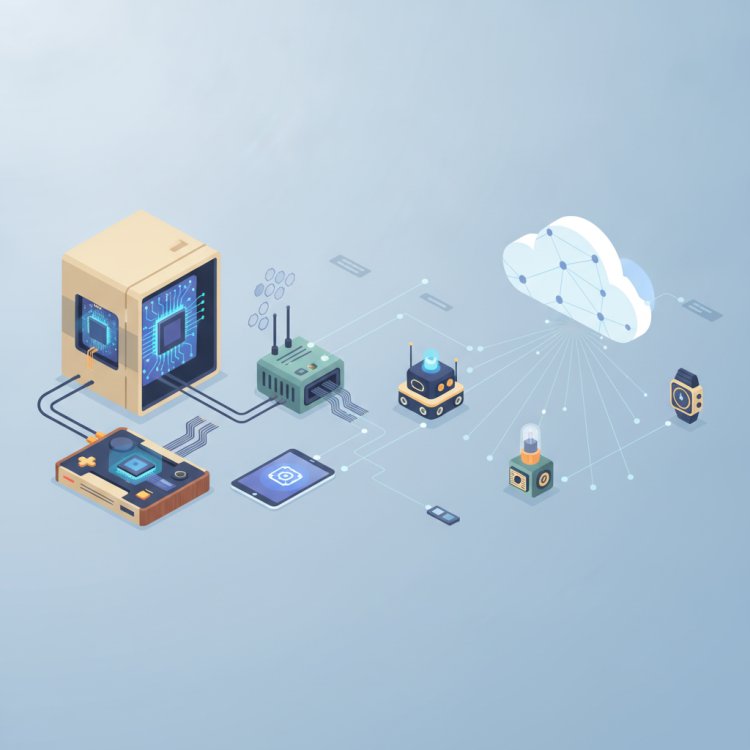
There is a distinct, lingering fascination in the tech community with reviving aging hardware. Across developer forums and maker spaces, enthusiasts routinely pull apart vintage machines—from decades-old handheld gaming consoles to abandoned arcade cabinets and obsolete media players—and drop modern microcontrollers or single-board computers inside them. While casual observers might write this off as pure nostalgia or a weekend hobbyist pastime, looking closer reveals something far more technical: a masterclass in hardware adaptation, constraint management, and edge-native integration.
When you strip away the layers of novelty, retrofitting legacy devices with modern silicon offers a unique lens through which to examine today's Internet of Things. It forces developers and engineers to confront the exact same constraints that plague commercial IoT deployment: severe limitations in power, tight physical enclosures, outdated display protocols, and the eternal challenge of bridging legacy inputs with modern network stacks. Separating the genuine engineering breakthroughs from the social media hype cycle helps us understand why retro-modding principles are quietly informing modern edge design.
The Anatomy of a Retrofit: What Actually Happens Under the Hood
To understand the technical value of retrofitting vintage hardware, we have to look at what occurs when a modern embedded computer—such as a compact Raspberry Pi module or a specialized ARM-based microcontroller—is integrated into a shell designed twenty or thirty years ago.
In most cases, the original internal logic board is completely bypassed. However, the external physical interface—the buttons, the joysticks, the LCD panels, and the native power supplies—must be retained to preserve the authentic user experience. This requires a meticulous translation layer:
- Signal Translation: Mapping legacy tactile buttons and analog inputs to modern GPIO pins using custom wiring harnesses or custom interface boards.
- Power Management Overhaul: Replacing decades-old NiMH or primary battery cells with modern Lithium-ion or LiPo power banks, complete with safe charging circuits and step-down voltage regulators.
- Display Bridging: Interfacing modern digital video outputs (like HDMI or DSI) with older, non-standard LCD panels or composite screens, often requiring specialized driver boards and timing adjustments.
- Thermal Considerations: Designing passive or active cooling solutions inside cramped plastic enclosures that were never engineered to dissipate heat from a modern quad-core processor.
These challenges are not dissimilar to what industrial IoT engineers face when trying to bolt smart sensors onto legacy factory machinery built in the 1980s. The principles of non-destructive integration and protocol translation remain identical.
Cutting Through the Hype: Novelty Versus Real Engineering Utility
It is easy to get swept up in the aesthetic appeal of a sleek retro handheld running modern software, but we must separate viral internet content from true technological utility. Much of what trends online relies on heavily customized components, niche 3D-printed chassis, and hours of hand-soldering that could never scale to a commercial product.
However, beneath the aesthetic hype lies a core philosophy that heavily influences modern edge IoT: hardware longevity and modular repairability. In an era dominated by planned obsolescence and sealed electronic devices that cannot be opened without breaking, the retro-modding community champions the exact opposite ethos. They prove that the physical shell of a device can outlast its internal compute multiple times over if the architecture is designed with modularity in mind.
Consider the enterprise and smart home sectors. Manufacturers are increasingly pressured to move away from throwing away entire sensor hubs or smart panels when a single wireless chip or microcontroller goes end-of-life. The methodology pioneered by hardware modders—decoupling the physical interface from the core compute and networking layer—is a blueprint for sustainable product design.
Practical Takeaways for Edge IoT Developers
If you are building connected hardware or edge IoT systems today, studying how enthusiasts breathe new life into legacy tech offers several actionable design principles:
- Design for Interface Longevity: Separate your device's physical shell and input mechanisms from the core processing unit wherever possible. Modular internal layouts simplify future upgrades.
- Embrace Resource Constraints: Just because modern microcontrollers have abundant RAM and clock speed does not mean you should waste them. Developing for constrained retro hardware instills habits of memory efficiency and optimized power states.
- Master Protocol Conversion: Learn how to bridge analog signals and archaic serial communication protocols with modern IP-based networks. The ability to speak both legacy and modern languages is invaluable in industrial automation.
- Prioritize Power Density: Efficient power management is the bottleneck of both retro handhelds and field-deployed IoT sensors. Optimize your sleep states and voltage regulation early in the design phase.
Conclusion
The cultural obsession with repurposing classic hardware is much more than a nostalgic trip down memory lane. It serves as an organic testing ground for creative engineering, pushing developers to solve complex integration challenges within rigid physical boundaries. By observing how makers successfully marry yesterday's shells with tomorrow's silicon, we gain valuable insights into how to build more resilient, modular, and repairable connected devices for the modern edge.
As the IoT landscape matures, the most successful hardware architectures will likely adopt this exact mindset: treating compute as a replaceable, upgradable layer while honoring the physical durability of well-designed interfaces.